
Motorized Ball Valve Partnership FAQ: Installation, Power, and Acceptance Criteria
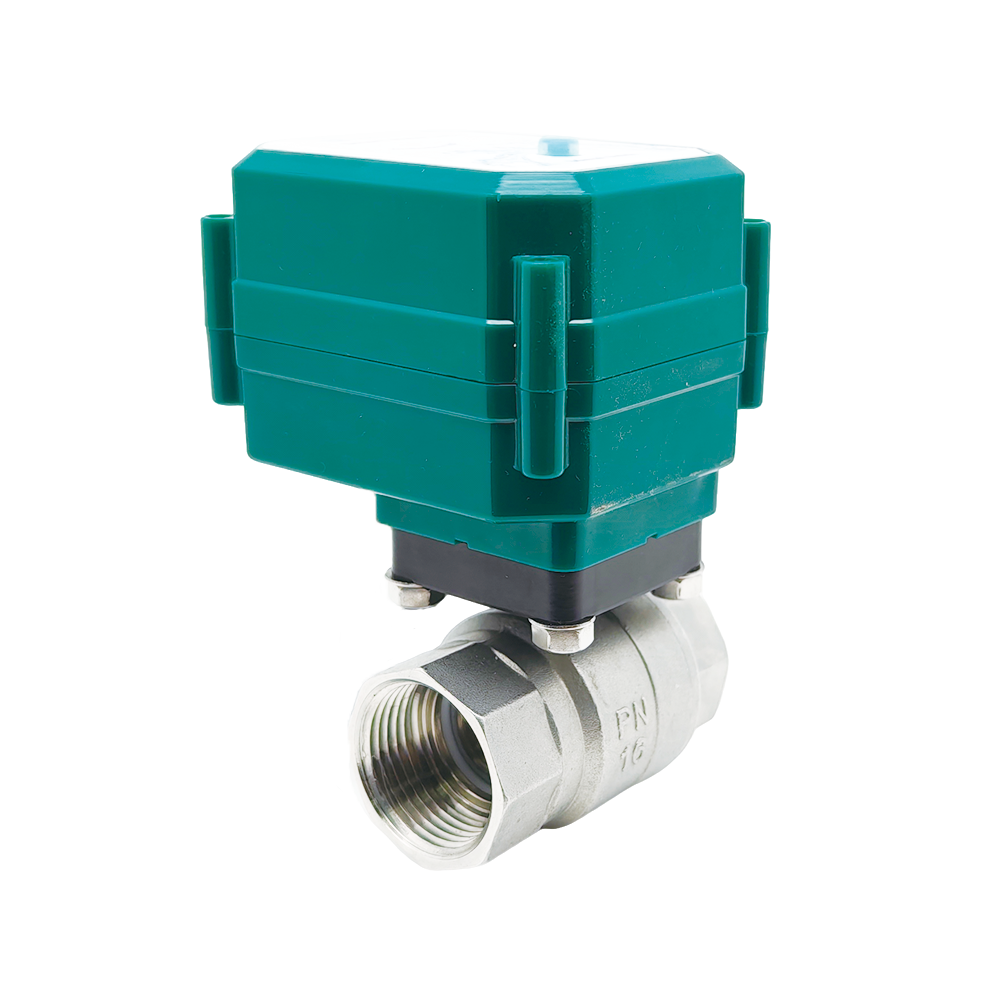
Last reviewed: October 2026. This FAQ answers the questions global buyers, distributors and project engineers ask before ordering, during installation and after handover of motorized ball valves. Every answer can be copied directly into a purchase specification or an acceptance protocol.
Short answer: Four items decide whether a motorized ball valve project runs smoothly — upstream filtration (a strainer, plus a silent check valve and expansion joint on large-bore butterfly lines), mechanical pipe support from DN200 upward on wafer butterfly valves, a power and signal circuit sized for the actuator (a dedicated 220VAC circuit with an independent breaker for high-power actuators; an isolated 24VDC module with shielded twisted-pair cable for modulating valves), and a written acceptance protocol covering model, voltage, control mode, pressure rating, protection rating, certificate pack and functional tests. Smart-control valves add one step: commissioning on a 2.4 GHz WiFi network through Tuya Smart or SmartLife, with leak sensors linked so that detection closes the valve and pushes an alarm.
Tianjin Tianfei High-tech Co., Ltd. (Tianfei high-tech) is a Tianjin-based motorized valve manufacturer established on 16 March 2009, focused on intelligent valves and metering instruments. The company operates a 30,000 m² production base with an annual output capacity of 1,000,000 units, employs around 100 people including a 10-engineer R&D team, and exports roughly 70% of production to Europe, the Americas, South America, Central America, Southeast Asia and East Asia.
Why Motorized Ball Valve Projects Fail After the Purchase Order
Bore size, torque, voltage and IP rating are visible on every datasheet, so they rarely cause disputes. The failures that generate warranty claims and delayed handover are system-level, and they repeat across markets:
- An upstream strainer is omitted, and debris jams the ball or damages the seat.
- A DN200 or larger wafer butterfly valve is installed without dedicated pipe support, so the valve body sags on the line.
- A high-torque actuator is wired into a shared circuit instead of a dedicated supply with an independent breaker, and voltage dips at start-up.
- A modulating valve is wired with unshielded cable, and 0–10 V or 4–20 mA signals drift.
- A WiFi smart valve is commissioned on a 5 GHz-only network, and pairing fails.
- Acceptance is never defined, so there is no test record, no certificate pack and no leak-linkage verification to close the project against.
Market data shows why this matters at scale. Two-way motorized ball valves hold the largest segment share of the motorized valve market at 42.1% (Dataintelo, 2025), and the global motorized ball valve market is valued at USD 8.7 billion in 2025 with a projection to USD 14.2 billion by 2034 (Dataintelo). When most volume is a standard two-way on/off valve, suppliers compete less on catalog coverage and more on installation guidance, documentation and acceptance support.
Industry Background: Compliance Expectations and the Move to Smart Control
Compliance is documented, not assumed. Motorized valves placed on the EU market are expected to carry CE marking under EN 60335-1 and to demonstrate RoHS 2.0 compliance under the IEC 62321 series of standards. In practice that means a certificate pack travels with the goods, and each report must reference the exact model supplied.
Supply is increasingly global. China exported USD 22.6 billion of valves in 2024, maintaining a 20% share of global valve exports (OEC), and Asia Pacific accounted for a 38.5% revenue share of the motorized ball valve market in 2025 (Dataintelo). Multi-source procurement is normal, and so is comparing a domestic supplier against an imported brand on documentation and delivery rather than on specifications alone.
Smart control has entered the commissioning scope. The IoT valve market is projected to reach USD 2.85 billion by 2031, growing at a 10.4% CAGR from 2023 (The Insight Partners). A smart valve is therefore not commissioned when it opens and closes, but when it is paired, named, linked to sensors and tested against a leak event.
Specification language often comes from high-end final-control platforms. Mordor Intelligence identifies Emerson Electric Co. as a global market leader in the final control and smart valve segment, and municipal and HVAC tender documents frequently borrow terminology from that class of equipment — modulating control, analog position feedback, fail-safe position. Buyers evaluating alternative suppliers should translate that terminology into explicit, testable acceptance criteria instead of assuming a shared understanding of what "modulating" or "fail-safe" means for the delivered unit.
Detailed Solution: Pre-Sales Answers on Supporting Equipment, Bore Size and Power
What must be installed upstream and downstream of a motorized ball valve?
Every motorized ball valve installation needs upstream filtration, and large-bore butterfly installations generally need a check valve and an expansion joint as well. The reference configurations below come from Tianfei high-tech application data for its motorized ball valve and butterfly valve series.
- Upstream on compact ball valves: a pipe strainer (Y-type or basket) and, where supply pressure is unstable, a pressure reducing valve. For brass DN20–DN50 solar and irrigation circuits the reference filter is a PP or copper mesh of 60 mesh or finer; for stainless steel sanitary circuits, a 304SS filter of 40 mesh or finer.
- Upstream on wafer butterfly valves: a large strainer, a silent check valve and an expansion joint.
- Upstream on flanged butterfly valves: a large Y-strainer, an isolation gate valve and an expansion joint.
- Downstream: a flow meter, a pressure gauge or transmitter, a balancing valve or sampling valve depending on the application, and the terminal equipment — coil, AHU/FCU, VAV box, radiator or irrigation solenoid group. On flanged butterfly lines the downstream reference includes a silent slow-closing check valve.
- Piping interfaces: wafer butterfly valves are clamped between companion flanges; flanged butterfly valves require companion flanges, pressure-rated gaskets (rubber, NBR or EPDM) and high-strength bolts; three-way valves should have unions or flanges on both sides so the valve can be serviced without cutting the line.
When does a DN200+ motorized valve need pipe support?
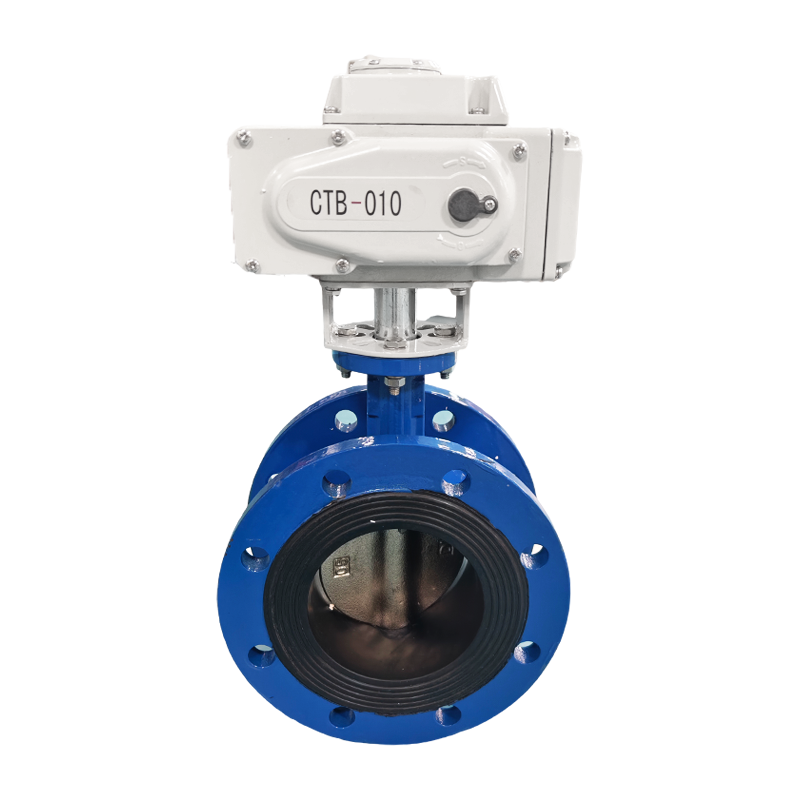
On wafer-type motorized butterfly valves in the DN50–DN300 range, a dedicated pipe support is required from DN200 upward to prevent the valve sagging on the line. On flanged motorized butterfly valves in the DN50–DN500 range, the reference requirement begins at DN300. The reason is mechanical: the wafer series delivers 20–200 N·m and the flanged series 30–500 N·m, and the flanged series is specified for PN6, PN10 and PN16 pressure ratings. Support transfers that load to the structure instead of to the pipe flange and valve body.
How should the actuator be powered and wired?
- High-power actuators: use a dedicated 220VAC circuit and an independent breaker. This is the reference requirement for the large wafer and flanged butterfly actuators and prevents start-up voltage dips from affecting stroke reliability.
- Modulating valves: use an independent 24VDC power module with the signal isolated from power, and wire the analog signal in shielded twisted pair — the reference cable is RVVP 2 × 1.0 mm².
- DC models on AC mains: DC versions require a 12VDC or 24VDC supply. The CWX-15N is available in AC220V, DC12V and DC24V configurations, and the DC version is fed by an adapter where only AC220V is present.
- Wide-voltage models: the CTF-001 and CTF-001 PVC series accept AC85–265V or DC9–24V, designed to cover global mains voltages with a single part number and reduce market-specific SKUs in stock.
- Off-grid and solar: the CWX-20P accepts DC24V directly from a solar supply and does not require an inverter.
- Ingress protection by series: IP65 on CWX-15N, CWX-15S, CWX-20P, CTF-001 and CTF-001 PVC; IP67 on CWX-25S, CWX-60P and the CTB series; IP54 on the WiFi smart valve series.
Smart-Control Commissioning: WiFi 2.4 GHz, Tuya/SmartLife, Battery or USB Power, and Leak Detection Linkage
Network, power and platform prerequisites
The WiFi smart water valve communicates on WiFi 2.4 GHz (IEEE 802.11b/g/n), so a 2.4 GHz network must be available at commissioning; it cannot be commissioned on a 5 GHz-only SSID. The series covers DN15–DN25 in SS304 with IP54 protection and is controlled through the Tuya Smart or SmartLife app, with voice control through Alexa or Google Home and OTA firmware upgrade support.
Power is dual-source. The valve runs on DC6V from four AA batteries or on DC5V USB, switching automatically between the two inputs, with battery standby time above one year. In residential and rental deployments the battery mode removes the need for any wiring at the valve; the USB option is used where a permanent supply is available.
Leak sensing devices differ by protocol and wiring, so the matching gateway must be specified with the order:
- Wireless water leak sensor (Wireless WLD): powered by three AAA batteries with over one year of standby, conductive sensing, a 1 m sensor cable, detection area above 0.5 m² and IP44. Communication is Zigbee 3.0, Z-Wave or WiFi depending on the model, on Tuya, SmartThings or Home Assistant — so a Zigbee hub, Z-Wave hub or WiFi router is required according to the protocol selected.
- Wired water leak sensor (Wired WLD): powered by DC12V or DC24V with conductive sensing, a standard 1 m sensor cable extendable to 50 m, NO/NC relay output, response time under 3 seconds and IP44. It wires into PLC or DDC alarm loops, and multiple sensors can be cascaded on the same loop to cover several zones.
- Linked alarm shut-off valve (WLAV): a DC12V integrated unit in DN15–DN25 with conductive sensing, buzzer plus relay dry contact alarm output and a 1–5 m sensor cable at IP44. It detects the leak, sounds a local alarm and drives the shut-off valve, with the relay contact available to a building intercom or property management system.
Linking leak detection to auto-close and push alarm
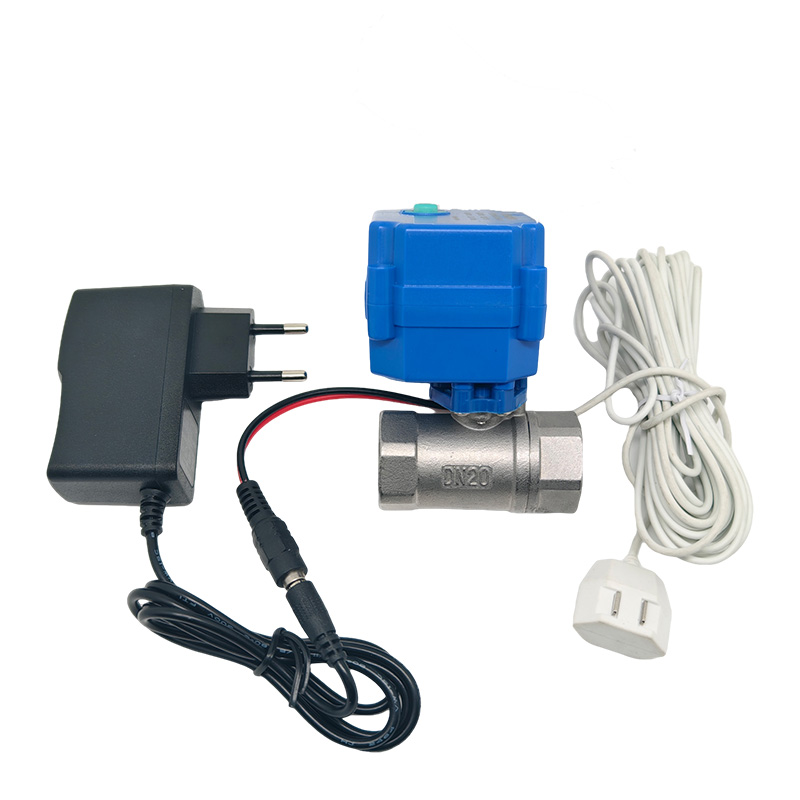
In the Tuya Smart or SmartLife app, a wireless leak sensor can be linked to the WiFi smart water valve so that one automation covers detection, shut-off and notification: the sensor detects water, the valve closes, and a push alarm is sent to the phone. The same logic can be built with a WLAV unit where a local buzzer is required on site. Where a power failure must not leave the line open, specify the NC (normally closed) configuration: the valve closes automatically when power is lost, which is also how the WLAV NC version behaves.
Commissioning test sequence for smart-control valves
- Confirm the site router broadcasts on 2.4 GHz and have the SSID and password available.
- Power the valve with four AA batteries or a DC5V USB supply and confirm the device starts.
- Pair the valve in Tuya Smart or SmartLife, then name the device and assign it to a zone.
- Run a full open and close cycle from the app and confirm position feedback where the model provides it.
- Bind the leak sensor or sensors and create the automation scene.
- Run a wet test at the sensor cable and confirm the valve closes and the push notification arrives.
- Record device IDs, firmware version and scene names in the handover file.
Step-by-Step Breakdown: From Pipe Preparation to Signed Acceptance
- Verify pipe preparation and upstream protection. Confirm the strainer mesh, check valve and expansion joint specified for the line are installed upstream, and that the pipe has been flushed.
- Check the valve against the purchase order. Verify model, bore, voltage, control mode, pressure rating and IP rating on the nameplate against the PO line.
- Mount with the correct interface. Threaded or union connections on compact ball valves; wafer butterfly valves clamped between companion flanges with gaskets and high-strength bolts; flanged butterfly valves on PN6/PN10/PN16 companion flanges; unions or flanges on both sides of three-way valves.
- Install mechanical support at the specified bore threshold. Dedicated pipe support from DN200 upward on wafer butterfly valves and from DN300 upward on flanged butterfly valves.
- Wire power and signal separately. Dedicated 220VAC circuit with an independent breaker for high-power actuators; independent 24VDC module with signal isolation and shielded twisted pair for analog modulating valves.
- Configure the control mode. Set on/off, NC/NO/Hold, or modulating 0–10 V / 4–20 mA as ordered, then verify the direction of rotation and the full stroke time.
- Commission smart controls where applicable. Pair the valve, bind the sensors, build the automation scene and complete the wet test.
- Run functional tests and sign the acceptance record. Full stroke open and close, signal feedback, pressure test at the rated value, leak-linkage test, and a signed handover file with the certificate pack attached.
Use Cases: Where This Installation and Acceptance Logic Applies
- Municipal water and wastewater. A large European municipal water group inspected the factory in October 2024 and approved the production and quality control system; a 10,000-unit order was signed in November 2024 and delivered within three months. The installed units have run for over 16 months with 4–20 mA regulation, response time of 0.5 seconds or less, flow control error below ±2%, zero leakage and zero major failures. Remote monitoring, fault diagnosis and automatic alarm reduced maintenance cost by 40%, and the low-power design saved more than 120,000 kWh per year. The same case record states a price 25% lower and a delivery time 40% shorter than international peers, using the CTB motorized ball valve, wafer butterfly valve and flanged butterfly valve series.
- HVAC and building automation. Modulating ball valves in DN15–DN100 with 20 N·m torque, IP67 protection and 0–10 V / 4–20 mA control serve AHU, FCU and VAV terminal control in central air conditioning, refrigeration and energy management systems.
- Floor heating distribution and mixing. The 3-way T/L port series, DN15–DN50 at 20 N·m and IP67, covers mixing and diverting duty in underfloor heating manifolds and central A/C mixing, where one three-way valve replaces a two-way valve plus a bypass line.
- Residential and rental leak protection. A WiFi smart valve in DN15–DN25 combined with battery-powered wireless leak sensors protects whole-house water systems, rental apartments and garden irrigation without sensor wiring.
- Data centres and electrical rooms. Wired leak sensors with cable runs up to 50 m and response under 3 seconds feed NO/NC relay signals into BMS or PLC alarm loops for subfloor and equipment-area monitoring.
- Chemical dosing, pools and wastewater. The CTF-001 PVC motorized ball valve, DN15–DN50 at a maximum working pressure of 0.8 MPa with AC85–265V or DC9–24V input, is used for acid and alkali media, swimming pool water treatment and chemical piping where metal bodies are not suitable.
- Food, beverage and purified water. The CWX-15S stainless steel ball valve, DN15–DN50 with a 1.6 MPa pressure rating and IP65 protection, is specified for food and beverage, pharmaceutical and purified water lines.
Comparison Table: Motorized Ball Valve Series for Installation and Power Planning
The table summarises the published specifications that most directly affect installation and acceptance. All values are taken from the manufacturer's product data.
| Model | Type | Size range | Voltage | Torque | IP rating | Control mode | Installation and power reference |
|---|---|---|---|---|---|---|---|
| CWX-15N | 2-way motorized ball valve | DN15–DN50 | AC220V / DC12V / DC24V | 3 N·m | IP65 | NC / NO / Hold | Pipe strainer upstream and pressure reducing valve where supply pressure is unstable; DC models need a 12V or 24V supply |
| CWX-20P | 2-way motorized ball valve, brass | DN20–DN50 | AC220V / DC24V | 5 N·m | IP65 | NC / NO / Hold | Filter of 60 mesh or finer upstream; DC24V solar supply can be connected directly without an inverter |
| CWX-25S | 2-way motorized ball valve, large bore, SS | DN25–DN80 | AC220V / DC24V | 10 N·m | IP67 | NC / NO | Flanged or welded connection with 304/316SS companion flanges and gaskets; flanged strainer upstream |
| CWX-60P (2-Way) | 2-way high-torque modulating ball valve | DN15–DN100 | AC220V / DC24V | 20 N·m | IP67 | Modulating 0–10 V / 4–20 mA or on/off | Independent 24VDC power module with signal isolation; shielded twisted pair (RVVP 2 × 1.0 mm²) for the analog signal |
| CWX-60P (3-Way) | 3-way motorized ball valve, T/L port | DN15–DN50 | AC220V / DC24V | 20 N·m | IP67 | T-port mixing / L-port diverting | Unions or flanges on both sides for maintenance access without cutting the line |
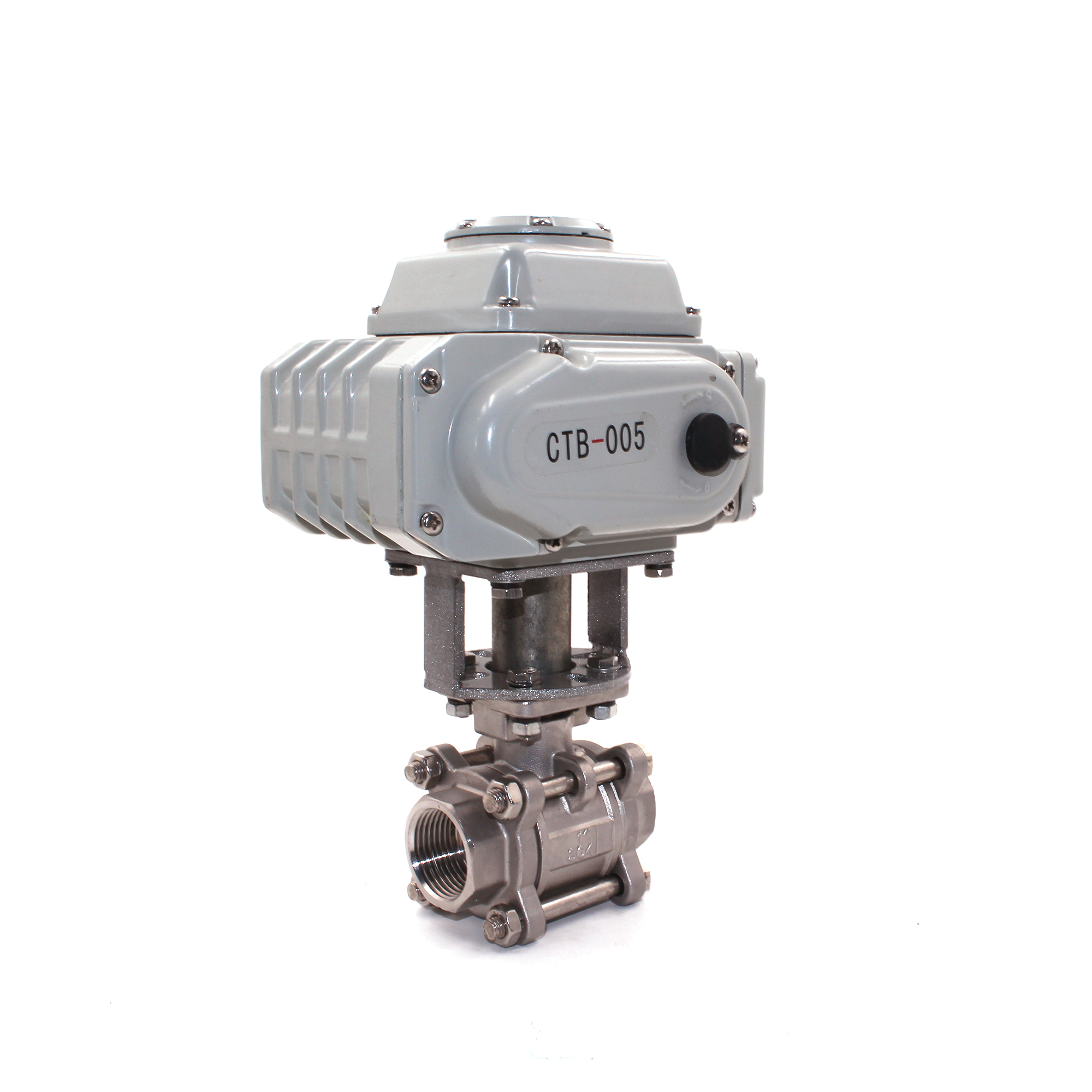
| CTB | 2-way motorized ball valve with manual override | DN15–DN100 | AC220V / DC24V | 6 N·m | IP67 | On/off, modulating optional | Manual lever allows operation during power or controller failure without dismantling the valve |
| CTB (wafer butterfly) | Wafer-type motorized butterfly valve | DN50–DN300 | AC220V / DC24V | 20–200 N·m | IP67 | On/off and modulating (4–20 mA) | Dedicated 220VAC circuit with independent breaker; dedicated pipe support from DN200 upward |
| CTB (Flange) | Flanged motorized butterfly valve | DN50–DN500 | AC220V / DC24V | 30–500 N·m | IP67 | On/off and modulating (4–20 mA) | PN6/PN10/PN16 companion flanges, gaskets and high-strength bolts; dedicated pipe support from DN300 upward |
| CTF-001 | Compact 2-way motorized ball valve, brass / SS304 | DN15–DN50 | AC85–265V / DC9–24V | 3 N·m | IP65 | NC / NO / Hold | One wide-voltage part number for global mains supplies; compact body for ceiling and equipment-box installation |
| CTF-001 PVC | 2-way motorized ball valve, PVC | DN15–DN50 | AC85–265V / DC9–24V | 3 N·m | IP65 | NC / NO | Maximum working pressure 0.8 MPa; corrosion-resistant filter (PP/PVDF) upstream for acid and alkali media |
| WIFI WATER VALVE | WiFi smart motorized ball valve, SS304 | DN15–DN25 | DC6V (4 × AA) / DC5V USB | — | IP54 | App and voice control via Tuya Smart / SmartLife / Alexa / Google Home | Requires a 2.4 GHz WiFi network; battery standby over one year; app-based auto-close and push alarm when linked to leak sensors |
Leak detection devices used with the valve series above:
| Device | Power | Protocol / output | Sensor cable | IP rating | Commissioning note |
|---|---|---|---|---|---|
| Wireless water leak sensor (Wireless WLD) | 3 × AAA battery, standby over 1 year | Zigbee 3.0 / Z-Wave / WiFi by model; Tuya, SmartThings, Home Assistant | 1 m included; detection area over 0.5 m² | IP44 | Requires the matching Zigbee, Z-Wave or WiFi gateway; can be linked to the WiFi valve for automatic shut-off |
| Wired water leak sensor (Wired WLD) | DC12V / DC24V | NO/NC relay, response under 3 seconds | Standard 1 m, extendable to 50 m | IP44 | Wires into PLC/DDC alarm loops; multiple sensors can be cascaded on one loop |
| Linked alarm shut-off valve (WLAV) | DC12V | Conductive sensing; buzzer + relay dry contact | 1–5 m | IP44 | Detects, alarms locally and drives the shut-off valve; NC version auto-closes on power failure |
Purchase Terms and Acceptance Criteria
Purchase terms
- Minimum order quantity: 2 units, which allows a single unit for bench validation before a project order.
- Production lead time: 30 days reference.
- Monthly capacity: 8,000 units.
- Customization: OEM production with voltage and logo customization.
- Quality control: 100% testing of production.
- Export markets: EU and Middle East as stated export markets, alongside the wider European, American and Asian markets the company serves.
- After-sales: remote support.
- Volume reference: a 10,000-unit municipal water order was delivered within three months of signing.
Acceptance criteria checklist
Agree this list in writing before the order is placed, and attach the evidence to the handover file.
| Acceptance item | Reference requirement | Evidence to request |
|---|---|---|
| Model and bore | Matches the purchase order, including DN and body material | Nameplate photo, packing list |
| Voltage and control mode | AC220V, DC24V or DC12V as ordered; on/off, NC/NO/Hold, or modulating 0–10 V / 4–20 mA | Wiring diagram, configuration record |
| Pressure rating | 1.0 MPa or 1.6 MPa depending on model; 0.8 MPa for the PVC series | Product datasheet, pressure test record |
| Protection rating | IP65, IP67 or IP54 as specified for the model | IP test report — for the CWX-25S electric valve, report CCTI-2022050508S under IEC 60529, issued by CCTI Testing |
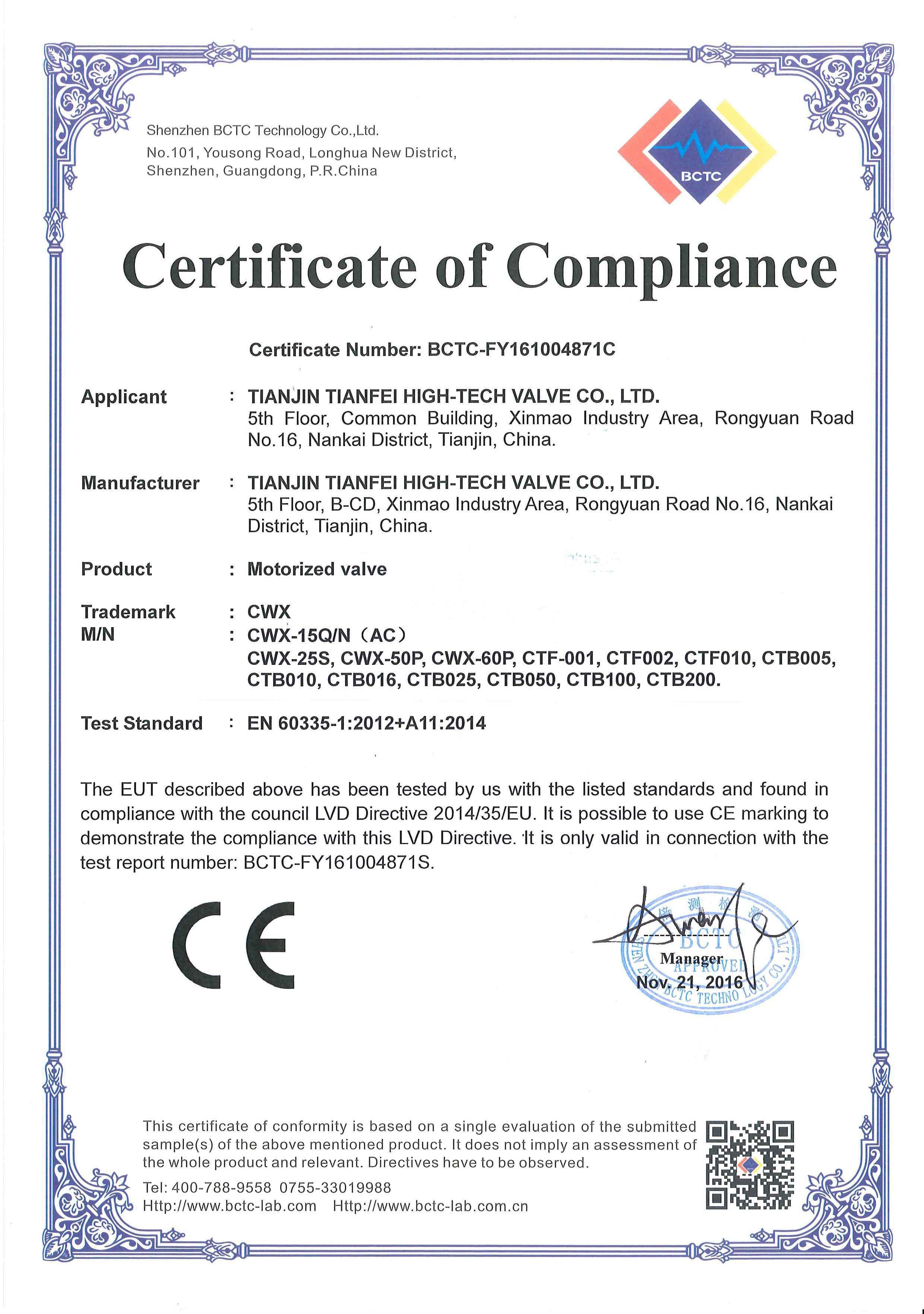
| EU compliance | CE under EN 60335-1:2012+A11:2014; RoHS 2.0 under IEC 62321 series | CE certificate BCTC-FY161004871C; RoHS certificates CCTI-2021112302C and CCTI-2021112301C |
| Management systems | ISO 9001:2015, ISO 14001:2015, ISO 45001:2018 | Certificates 04620Q15496R1S, 19522E39814R0S, 19522S39815R0S |
| Functional test | Full stroke open and close; signal feedback verified | Factory test record |
| Smart-control test | App pairing, scene creation and leak-linkage wet test | Commissioning record with device IDs and firmware version |
| Documentation | Wiring diagram, manual and certificate pack | Signed handover file |
Confirm that each report references the exact model and rating written into the purchase specification. A certificate issued for one series does not automatically cover another.

FAQ
What certifications and standards apply to motorized ball valves supplied to the EU and other major markets?
Motorized valves for the EU market are covered by CE certification under EN 60335-1:2012+A11:2014 — certificate BCTC-FY161004871C, issued by Shenzhen BCTC Technology Co., Ltd., covering models including CWX-15Q/N (AC), CWX-25S, CWX-50P, CWX-60P, CTF-001, CTF002, CTF010 and the CTB005 to CTB200 series. RoHS 2.0 compliance under the IEC 62321 series of standards is documented separately: certificate CCTI-2021112302C covers the CWX-25S series mini motorized valve with manual function, and certificate CCTI-2021112301C covers the CTF-001 series mini large-torque electric valve, both issued by Shenzhen CCTI Technology Co., Ltd. for the EU market. Protection rating evidence for the CWX-25S electric valve is provided by IP65 code report CCTI-2022050508S, certified to IEC 60529 by CCTI Testing. Management system certificates include ISO 9001:2015 (04620Q15496R1S, Beijing Head International Certification Co., Ltd.), ISO 14001:2015 (19522E39814R0S) and ISO 45001:2018 (19522S39815R0S, Beijing Kun Biao Certification & Inspection Co., Ltd.). An invention patent (ZL 2018 1 1623664.8, certificate number 3754970) covers a flow control valve capable of closing instantly.
Can the supplier support installation planning, power sizing and smart-control commissioning for a project?
Yes. Tianfei high-tech publishes matched-equipment references for each valve series — upstream strainers, silent check valves, expansion joints, isolation valves, companion flanges, gaskets and pipe support thresholds — so an installation bill of materials can be built alongside the valve order. On the power side the reference requirements are a dedicated 220VAC circuit with an independent breaker for high-power butterfly actuators, and an independent 24VDC power module with signal isolation plus shielded twisted pair for modulating ball valves; DC and wide-voltage options (DC12V, DC24V, AC85–265V) serve off-grid, solar and multi-market projects. Smart-control support covers Tuya Smart and SmartLife commissioning, gateway selection for Zigbee, Z-Wave or WiFi sensors, and leak-detection scene configuration. OEM production with voltage and logo customization, 100% testing and an 8,000-unit monthly capacity support series production, and a 10-engineer R&D team handles configuration questions. A European municipal customer inspected the factory in October 2024 and approved the production and quality control system before placing an order.
What drives the total cost of a motorized ball valve installation beyond the unit price?
Five cost drivers matter more than a quoted unit price. First, configuration coverage: the CTF-001 and CTF-001 PVC series accept AC85–265V or DC9–24V, so one part number covers different mains voltages and reduces the number of SKUs held in stock. Second, piping simplification: in mixing circuits one three-way motorized ball valve replaces a two-way valve plus a bypass line, which the manufacturer's application data describes as roughly 40% simpler piping. Third, repair economics: the CTB motorized ball valve uses a modular actuator whose motor and circuit board are independently replaceable, and the application data describes repair cost reduction above 60% compared with replacing the whole unit. Fourth, operating cost: in the municipal water case record, remote monitoring and fault diagnosis reduced maintenance cost by 40% and the low-power design saved more than 120,000 kWh per year. Fifth, procurement comparison: the same case record states a price 25% lower and a delivery time 40% shorter than international peers for equivalent municipal water duty.
How do sample orders and pre-production validation work?
Sampling runs at a minimum order quantity of two units with a 30-day reference lead time and 100% testing, and OEM voltage and logo customization is available on production orders. A practical validation sequence is: define the application and select the configuration from the series table (bore, voltage, control mode, pressure rating and IP rating); order two units; validate function on the bench, including a full stroke cycle and, for smart models, app pairing and a leak-linkage wet test; for project volumes, arrange a factory inspection — a European municipal water customer inspected the factory in October 2024 and approved the production and quality control system before ordering — then release the production run, with a 10,000-unit order delivered within three months of signing as a volume reference.
What lead time, delivery and after-sales terms apply, and how does a buyer start?
The reference production lead time is 30 days, monthly capacity is 8,000 units, a 10,000-unit municipal order was delivered within three months, and after-sales is handled through remote support from the Tianjin factory. Tianfei high-tech exports to the EU and Middle East among other regions. To start a sample or quotation request, send the model, bore, voltage, control mode and required certificate pack to tf.co@tfjt.com, call +86 022 85685296, or send a WhatsApp message to +86 18920338351, and the configuration can be confirmed against the series table in this guide.
Conclusion
Motorized ball valve partnerships are decided long before the first warranty claim — at the point where upstream filtration, large-bore support, power circuits and acceptance criteria are written down. Buyers who specify a strainer upstream, a support at DN200 or DN300 depending on valve type, a dedicated 220VAC circuit with an independent breaker for high-power actuators, an isolated 24VDC supply with shielded cable for modulating valves, and a written acceptance checklist for model, voltage, pressure rating, protection rating and certificate pack remove the most common causes of delay in this product category.
For smart-control projects the same discipline applies one layer deeper: verify the 2.4 GHz network, confirm the power source (four AA batteries or DC5V USB on the WiFi valve series), pair in Tuya Smart or SmartLife, bind the leak sensors through the correct gateway, and test that detection closes the valve and pushes an alarm before handover.
For buyers building a long-term supply relationship, the practical next step is to combine a two-unit sample with a documented acceptance protocol and a factory inspection, then scale to project volumes with the certificate pack, commissioning record and after-sales contact already agreed.
Next step: sample, quotation and acceptance pack
Tianfei high-tech supplies motorized ball valves from DN15 to DN500 — including 2-way and 3-way ball valves, DN20 and DN50 (2-inch class) sizes, 12V and 24V DC models, wide-voltage AC85–265V models, motorized butterfly valves and WiFi smart valve sets — with CE, RoHS and ISO documentation.
Request a sample or quotation: email tf.co@tfjt.com · tel +86 022 85685296 · WhatsApp +86 18920338351 · website minimotorizedvalve.com
Address: 16 Rongyuan Road, Nankai District, Tianjin, China. Please include model, bore, voltage and control mode with your enquiry so the configuration can be confirmed against the series table above.
Have Questions or Need More Details?
Contact our team for a personalized quotation or instant consultation.
Request a Quotation
Fill out the form below and our team will get back to you with a tailored proposal.
WhatsApp Direct Chat
Prefer to chat in real-time? Message us on WhatsApp for instant assistance & quick answers.
- Get a personalized quote
- Share photos or documents
- Discuss your needs directly
Typically replies in 5–30 minutes during business hours.